
"Traditionally, forming a team to solve this problem would take weeks, and technically you couldn't make that decision this fast. With VROC, we can act immediately"
- Head of Offshore Operations
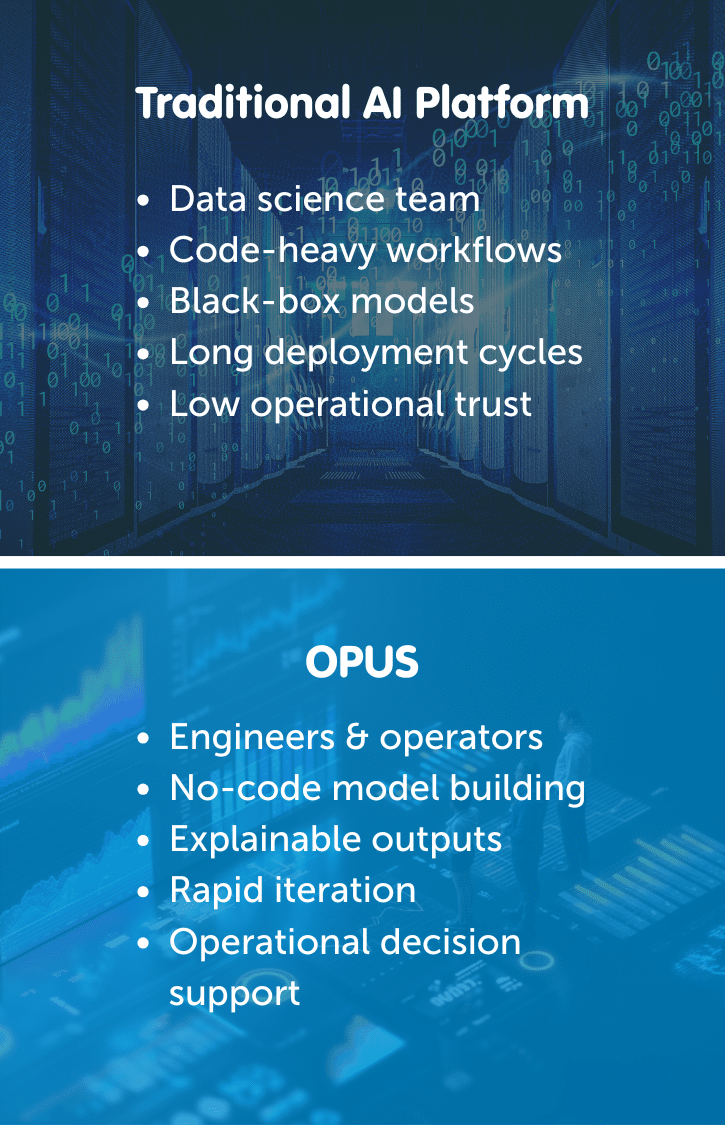
OPUS is VROC’s industrial AI platform, purpose-built for engineers and operators working in complex, asset-intensive environments. It enables teams to monitor performance in real time, predict failures before they occur, and optimise operations across the full asset lifecycle — without relying on large data science teams or bespoke software projects.
Unlike traditional analytics tools or generic AI platforms, OPUS is designed specifically for industrial time-series data, operational decision-making, and deployment at scale across plants, fleets, and enterprises.
OPUS provides the foundation for VROC’s core solutions, including:
Real-Time Monitoring & Operations
Deviation Management
Asset Performance & Life Extension
These solutions are delivered through a single, integrated platform — ensuring insights are trusted, explainable, and actionable by the people responsible for operations.
Get Started Today
OPUS continuously ingests and processes live operational data, providing engineers with immediate visibility into asset health and performance.
* Live dashboards with KPI-to-sensor traceability
* Asset-level and fleet-level monitoring
* Deviation detection from normal operating conditions
* Integrated alarm rationalisation and prioritisation
* Support for remote and distributed operations
This ensures teams are not just monitoring data, but understanding what matters, why it matters, and where to act.
OPUS enables a shift from reactive or rule-based maintenance to true predictive maintenance.
* Time-to-Failure (TTF) and Remaining Useful Life (RUL) predictions
* AI-defined operating envelopes rather than static thresholds
* Early detection of abnormal behaviour before alarms trigger
* Root cause analysis grounded in real operational context
* Maintenance prioritization based on risk and impact
The result is fewer unplanned outages, improved asset availability, and extended equipment life — all while keeping engineers in control of decisions.
OPUS supports continuous optimisation of processes and production by combining real-time data with advanced analytics and simulation.
* Digital twin and simulation capabilities
* Free-form calculations and engineering logic
* Performance benchmarking across assets or sites
* Sensitivity analysis and scenario testing
* Identification of efficiency losses and optimisation opportunities
This allows teams to test changes virtually, understand trade-offs, and optimise performance without risking production or safety.
OPUS removes the traditional barriers to industrial AI adoption.
No-code AutoML for model creation and deployment
Self-serve analytics for engineers and operators
Explainable AI outputs that align with engineering intuition
Rapid iteration with subject matter experts
Engineers remain responsible for decisions — OPUS provides the intelligence to support them.
OPUS is built to scale across assets, sites, and enterprises.
Automated model training, deployment, and monitoring
Built-in MLOps without custom pipelines
Support for bring-your-own models (BYO)
Centralized governance with local operational control
This ensures models don’t just get built — they stay accurate, trusted, and in use.
OPUS supports a wide range of industrial deployment environments.
Integration with existing sensors, PLCs, SCADA, and historians
Pre-configured communications gateways
Support for legacy and modern infrastructure
On-premise
Edge
Cloud
Hybrid architectures
This flexibility allows OPUS to operate in constrained, regulated, or remote environments — including critical infrastructure and defence applications.
OPUS follows a proven implementation approach. This enables organisations to move beyond pilots and deliver measurable operational value in weeks, not years.




To existing data sources
Across assets and sites
Using no-code and AutoML tools
Gain insights to guide decision making
OPUS supports operations from commissioning through to late-life asset management, enabling:
Continuous monitoring and optimisation
Early detection of degradation
Informed maintenance and capital planning decisions
Improved safety, reliability, and sustainability outcomes
OPUS is trusted in complex, high-consequence environments where uptime, safety, and performance matter.
It is not a generic analytics tool — it is an industrial AI platform built for real operations, real constraints, and real decisions.
Explore Industrial AI Solutions with OPUSWhether you’re launching your first pilot or scaling AI across your enterprise, VROC’s end-to-end platform and expert team can help you unlock data, optimise performance, and accelerate results.
Interested in a demo of one of our data solution products?
DataHUB4.0 is our enterprise data historian solution, OPUS is our Auto AI platform and OASIS is our remote control solution for Smart Cities and Facilities.
Book your demo with our team today!
Complete the form below and we’ll connect you with the right VROC expert to discuss your project. Whether you’re launching a pilot, scaling AI across your enterprise, or integrating complex systems, we’ll help you turn your data into actionable insights—fast, efficiently, and with confidence.
The efficient deployment, continuous retraining of models with live data and monitoring of model accuracy falls under the categorisation called MLOps. As businesses have hundreds and even.
Learn more about DataHUB+, VROC's enterprise data historian and visualization platform. Complete the form to download the product sheet.
Learn how OASIS unifies your systems, streams real-time data, and gives you full control of your smart facility—remotely and efficiently. Complete the form to access the product sheet.
Discover how OPUS, VROC’s no-code Industrial AI platform, turns your operational data into actionable insights. Complete the form below to access the product sheet and learn how you can predict failures, optimise processes, and accelerate AI adoption across your facility.
Interested in reading the technical case studies? Complete the form and our team will be in touch with you.
Subscribe to our newsletter for quarterly VROC updates and industry news.